
Atlas Forms - Whitepaper

Atlas Forms: Enterprise-Grade Dynamic Form Management at Scale
BizFirst Financial Intelligence | April 2026
1. Executive Summary
Enterprise organisations depend on data-collection forms for critical operations such as customer onboarding, compliance, and financial reporting. However, existing systems often fail to match this scale, forcing development teams into months of bespoke logic creation and locking out business analysts. Atlas Forms is a security-first platform built with React 18 and TypeScript strict mode. It provides a visual Form Studio for no-code authoring, a resilient SDK, and a unique schema inheritance model to solve form-related challenges across the modern enterprise.
2. The Problem: The Hidden Cost of Enterprise Form Development
Form management is a frequently underestimated challenge that scales exponentially with organisational size.
2.1 Development Complexity
A production-grade form requires more than simple markup; it needs conditional visibility, cross-field validation, real-time error messaging, and state management that survives network interruptions. Recreating these features across hundreds of applications leads to wasteful duplication and persistent inconsistencies.
2.2 Security Risk
Input forms are a primary attack surface for OWASP Injection and XSS. Without a centralised, audited engine, organisations are exposed to inconsistent sanitisation and insufficient output encoding. Furthermore, compliance mandates like PCI-DSS, HIPAA, and GDPR add layers of complexity that individual developers may not be trained to implement structurally.
2.3 Governance and Maintainability
Managing "families" of related forms—such as a master template with multiple regional variants—is impractical without a platform designed for explicit inheritance hierarchies. Failure to manage these dependencies results in delayed launches and engineering frustration.
3. Introducing Atlas Forms: Architecture
Atlas Forms is delivered as a 22-package pnpm monorepo designed to slot into any React 18 application.
3.1 The Four Architectural Layers
- Schema Layer (
schema-js): Defines structure via versioned JSON, handling parsing and inheritance resolution. - Engine Layer (
form-engine-js): Includes a DataBindingEngine for data mapping, an ExpressionEvaluator for logic, and a FormStateManager to track field state. - Presentation Layer: Features the Form Studio (
designer-components-react) for authoring and the Form Player (player-components-react) for end-user interaction. - Integration Layer (
client-js): Provides a unified SDK entry point for consuming applications.
4. Core Capabilities
4.1 The Form Engine
The engine operates statelessly relative to the network, eliminating latency and ensuring forms remain usable even when connectivity is intermittent. Business rules are declared in the schema, meaning logic changes do not require modifying application code.
4.2 88+ Pre-Built Controls
The platform includes an extensive library across six categories:
| Category | Examples |
|---|---|
| Input Controls | Text, Email, Password, Date, MultiSelect, Rating |
| Layout Controls | Section, Tabs, Accordion, Grid, Columns, Spacer |
| Advanced Controls | Signature, Address Autocomplete, IBAN, Currency |
| Media Controls | Image Upload, File Attachment, Camera, Audio Recorder |
| Chart Controls | Bar/Line/Pie Charts, Gauge (via Recharts) |
| Code / Rich Text | Monaco Editor, Quill Rich Text, Markdown Preview |
4.3 Schema Inheritance
Inheritance allows the API to resolve full ancestry chains (parent -> child -> grandchild). Field overrides at the child level take precedence, while parent updates propagate automatically to all descendants. This significantly reduces maintenance for organisations managing hundreds of variants.
4.4 Visual Form Studio
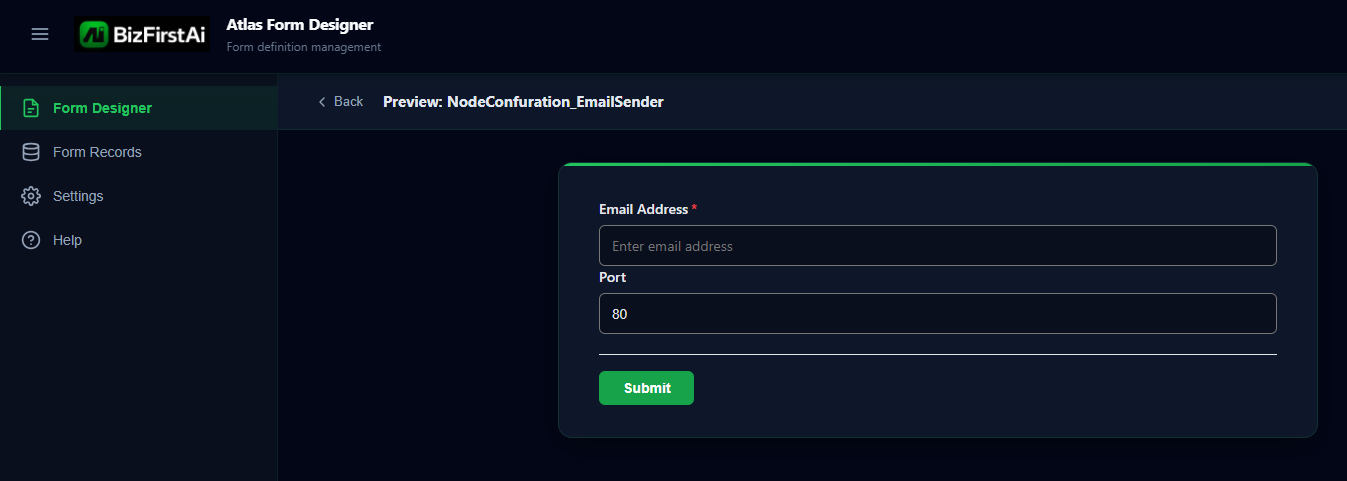
The Studio provides a no-code environment for business analysts to drag-and-drop controls, set validation, and preview results in real time. Every visually built form is automatically production-ready and compatible with the full security stack.
4.5 Validation and Persistence
The validation engine includes nine built-in rules (email, pattern, min/max, etc.) and is fully extensible. For draft recovery, the platform offers three storage adapters: LocalStorage, IndexedDB, and SessionStorage.
5. Security: A Six-Layer Defence Architecture
Security is a structural property of Atlas Forms, addressing over 28 distinct attack vectors.
| Layer | Mechanism | Threats Addressed |
|---|---|---|
| 1. Schema Validation | structural validation via schema-js |
Malformed injection, prototype pollution |
| 2. Input Sanitisation | DOMPurify sanitisation | Stored and DOM-based XSS |
| 3. Output Encoding | Encoding before DOM insertion | Reflected and second-order XSS |
| 4. CSP | strict-dynamic compatible headers |
Script injection via dependencies |
| 5. Validation Gating | Server-side revalidation | Validation bypass, API abuse |
| 6. Expression Sandboxing | Restricted scope execution | Arbitrary code execution |
6. Integration and Deployment
6.1 The Unified SDK
Integration begins with a single call to initialize the client, which configures APIs, auth state, and storage:
import { AtlasFormsClient } from '@atlas-forms/client-js';

AtlasFormsClient.initialize({
  apiBaseUrl: 'https://api.yourplatform.com',
  authToken: currentUser.token,
  storageAdapter: 'indexeddb',
  theme: 'light',
});
6.2 Deployment and State
The platform is backend-agnostic and ships with Docker configuration for both development (via Vite) and production. Application state is managed through Zustand stores, allowing deep integration with existing application shells.
7. Business Value and ROI
7.1 Accelerated Development
A complex form that typically takes 3–4 weeks to build from scratch can be delivered in 2–3 days using Atlas Forms. This allows organisations to recover months of engineering capacity.
7.2 Comparison Summary
| Value Dimension | Without Atlas Forms | With Atlas Forms |
|---|---|---|
| New Form Delivery | 3–4 weeks | 2–3 days |
| Authoring Roles | Developers only | Developers + Business analysts |
| Security Enforcement | Per-form basis | Platform-level, systematic |
| Template Changes | Manual updates | Automatic via inheritance |
| Draft Recovery | Custom per app | Built-in (3 options) |
8. Conclusion
Atlas Forms is an enterprise platform that treats form management as a first-class architectural concern. By addressing the full lifecycle—from authoring to long-term governance—it empowers organisations to accelerate digital transformation while maintaining rigorous security standards.
Contact the BizFirst Financial Intelligence team for a guided demonstration.